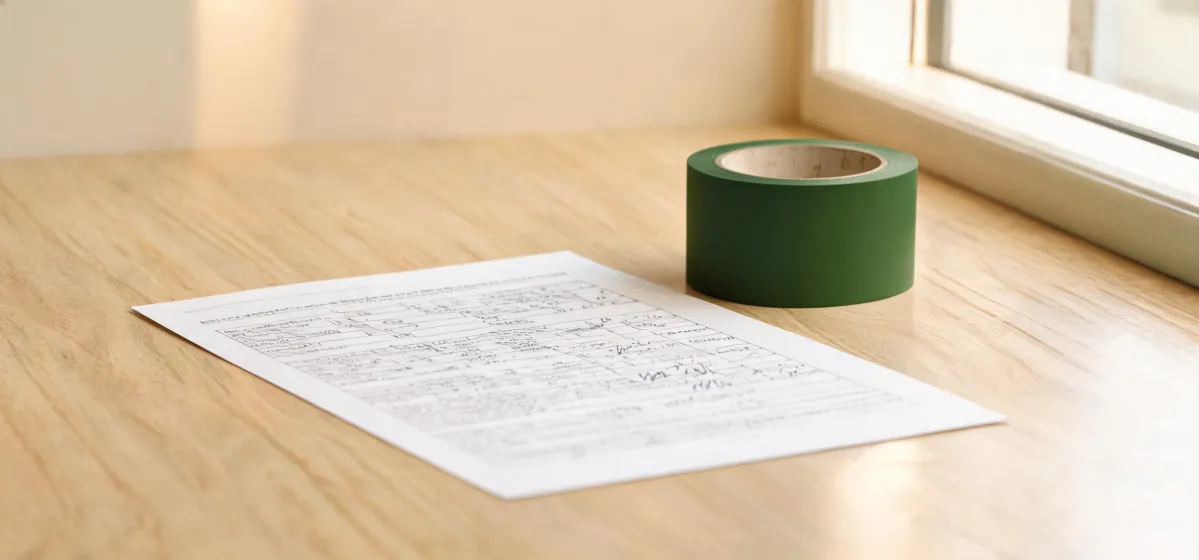
The Invoice That Didn't Match the Quote
In Q2 2023, I signed off on a $6,200 label invoice. That quarter, my approved quotes totaled $5,100. The $1,100 gap didn't sit on any single invoice. It was spread across six, in line items I never saw at the quote stage: one reprint, one expedited freight charge, one material upgrade, one color correction, and two "small" artwork revisions that turned into new plates.
Here's what nobody warns you about: custom roll labels look like a commodity in a quote, and behave like a specification in production.
I've tracked every label order we've placed for six years in a spreadsheet now — roughly $42,000 of cumulative spend across six product lines. The unit price we negotiated? It accounts for maybe 15% of what actually moved our costs. The other 85% came from decisions made after the purchase order was already signed.
If you think the problem is finding a cheaper price, you're measuring the wrong number.
The Real Problem: Spec Gaps, Not Pricing
Most buyers evaluate label suppliers by comparing price per thousand. That's a reasonable starting point, and a dangerous finish line, because a label isn't a single product — it's a bundle of specification choices.
Take a typical custom labels for jars order from our records. The quoted per-unit price for 12,000 labels might range from about $0.034 to $0.052 each, depending on the vendor. That looks like a real spread. But once you factor in:
- Substrate and adhesive choices. Paper vs. polypropylene, permanent vs. removable adhesive — each changes the web configuration, the die-cut, and the liner.
- Color approval cycles. Pantone matching requires a proof. Proofs run 3–7 days. If the color fails, you start over.
- Plates and setup. Every new die-cut shape carries a new tooling cost. That's not a per-unit cost — it's a fixed cost that swings with batch size.
The Pell-Mell industry standard for color tolerance is Delta E < 2 for brand-critical colors (reference: Pantone Color Matching System guidelines). Delta E of 2–4 is noticeable to trained observers. Above 4, most people can see it. If you approve a proof without specifying a tolerance in writing, you're gambling — and a failed color match means a full reprint.
Here's the part most buyers miss: a spec sheet isn't bureaucracy. It's the cheapest insurance you can buy.
The Cost of Rework (and the Invisible Downtime)
Let's put real numbers on what a reprint actually costs. A label reprint — even a modest 10,000-unit run — rarely just costs the print job. In our records, a reprint event typically includes:
- Reprint cost: full price, often without discount
- Freight: expedited, because you're already behind
- Machine downtime: 5–10 days where your line runs something else, or nothing
- Overtime: if the launch or run slipped, you're likely catching up on a weekend
- Approval time: someone has to re-check and sign off on the replacement
We buried about $4,800 in reprints alone last year — before counting the internal hours. And that's the conservative estimate.
The worst mistake I made — and yes, this one was mine — came on a water bottle labels custom job. I sent specs to three suppliers in one afternoon. One quoted about 18% lower than the others. I selected it. But I hadn't specified die-cut tolerance, and they didn't ask. The first shipment arrived with a web tension issue on the roll. The labels themselves were fine. The roll diameter deviation jammed our applicator. We switched to hand-application for two days.
That mistake cost roughly $1,200 in overtime and manual labor, and saved us $1,100 on the quote. The net loss was about $100 — plus two days of plant disruption, plus a rewritten label spec that I now have to defend every time we switch vendors.
I'm not a print engineer, so I can't speak to the adhesive chemistry or the slitting machine tolerances at that level. What I can tell you from a procurement standpoint is how to structure the process so the right questions get asked before the quote is signed.
Why This Isn't a One-Off Problem
There's a structural issue with label sourcing that rarely gets named: you almost never get the label right on the first pass.
A new custom labels for clothing program usually needs iterations: initial artwork → digital proof → prepress check → press proof → production. Each stage costs 2–7 days on most vendor timelines, and there are often a few days of internal approval between steps (a logo scaling decision, a resolution question, a bleed setting that nobody prioritized).
Honestly, for a seasonal program, the realistic timeline is around three weeks. Longer if you're scheduling around holidays.
That's why prevention is cheaper than correction. Not theoretically — materially. In our data, a reprint runs about 2.5× the cost of a first run that was properly checked.
So the question isn't "which supplier is cheapest?" It's "does my team actually know the required specification before quotes go out?"
The Approach That Actually Works: A Spec Checklist
I don't want to overcomplicate this, because it usually isn't complex — it's just a series of small assumptions that pile up. What we do now, before any RFQ goes out:
- Define the end-use parameters. Is the label going on a glass jar, soft clothing, a water bottle, or something else? The application method — hand-applied or high-speed applicator — drives everything from web direction to adhesive.
- Lock the material choice. Substrate, adhesive, liner. Write it down before you ask for pricing. Don't let the supplier guess, and don't let the low bidder imply a cheaper default without naming it.
- Confirm color specs and values. Pantone number (if required) and CMYK equivalents. If using Pantone, specify the tolerance you can live with (Delta E < 2 is a reasonable anchor). Accept that CMYK won't match Pantone exactly — reference the Pantone Color Bridge guide for the closet conversion.
- Check resolution. For commercial print, 300 DPI at final size is the standard. Verify your logo file. A 3000 × 2000 pixel image at 300 DPI tops out at 10 × 6.67 inches. Anything larger gets scaled and softened.
- Put the file list on paper and assign a verifier. Not a Slack message. Not a quick verbal OK. A reply-to email with the actual specs attached, and one person accountable for confirming every line.
I ask for every line of the checklist to be filled out and signed off on, because a "quick" message is where the $800 mistakes live. I learned that the hard way — not by choosing a terrible supplier, but by sending a vague RFQ and then picking the lowest bidder because the number felt competitive.
The Bottom Line
In six years of label ordering and roughly $42,000 in spend, I have not once found that the unit price was the problem. The costs that hurt came out of incomplete specs, slow approval loops, and a buyer who didn't understand that a label is a technical specification that happens to look like a purchasing decision.
The "free" proof can end up costing $200. The slower supplier that asks more questions tends to be cheaper in total than the fast one that doesn't ask any.
I don't have hard data on industry-wide defect rates — I wish I'd tracked that more carefully from year one — but based on our order logs, first-run quality problems run about 10–15%, and most of those were spec-related, not manufacturing defects.
That's the thing: it looks like sourcing. It's actually a specification problem wearing a price tag.
Comment
This page does not host a public comment thread. If a note leaves a specification field open, send the procurement requirement instead.